



Strategy
Your Work Environment Makes A Difference
A great workplace isn’t a perk. It’s a profit strategy. And a better life.
Organizations that build high-trust, high-performance cultures don’t just feel better to work in. They consistently outperform their peers on financial results, talent outcomes, innovation, and long-term resilience. When people experience respect, fairness, psychological safety, pride, and camaraderie, the entire organization moves forward together in one direction. It is a dynamic that your competitors cannot beat.
FREE REPORT
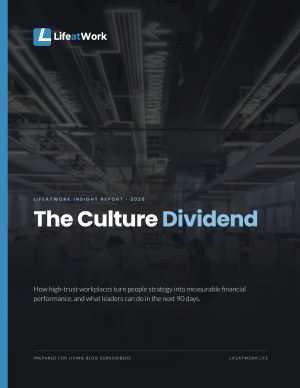
The Culture Dividend
Free for The Living Blog subscribers
The strategy behind every strategy
Culture is the strategy behind every strategy.
Every plan a leadership team writes, whether for growth, innovation, or customer experience, is carried out by people. When trust is high, strategy moves faster because employees understand the direction, believe in the people setting it, and choose to give their best. When trust is low, even a well-built plan stalls in hesitation, turnover, and disengagement.
Gallup’s 2024 meta-analysis of more than 183,000 business units found that the most engaged teams experience 63% fewer safety incidents, 32% fewer quality defects, and 10% higher customer loyalty than the least engaged. Those gains rarely come from a single program. They come from leaders who align culture, compensation, benefits, and communication so every part of the employee experience sends the same message: you matter here.
The Financial Decision
Higher revenue per employee. Lower voluntary turnover and hiring costs. Stronger, more resilient performance in uncertain times. Engagement isn’t a soft metric. It shows up on your P&L.
The WorkLife Decision
Lower burnout. Higher trust in leadership. A workplace where people bring their full effort because they feel safe, respected, and proud of where they spend their time. That matters just as much.
Seven categories of return
The Benefits, Category by Category
Every one of these outcomes is backed by research on high-trust, high-performance organizations. Here’s what changes when culture becomes a strategy instead of an afterthought, starting with the financial and organizational fundamentals below.
Business & Financial Performance
- Stronger long-term financial returns
- Higher revenue per employee
- Greater organizational resilience and stability
- Stronger performance during economic uncertainty
Talent Attraction & Retention
- Lower voluntary turnover
- Higher employee loyalty and commitment
- Stronger employer brand that attracts top talent
- Higher offer-acceptance rates and reduced hiring costs
Employee Engagement & Productivity
- Increased discretionary effort and motivation
- Higher productivity across teams
- Reduced absenteeism and presenteeism
- Stronger sense of pride and ownership in work
Culture, Trust & Leadership
- Higher trust in leadership and organizational direction
- Better communication, transparency, and credibility
- Stronger teamwork, collaboration, and camaraderie
- More inclusive, equitable, psychologically safe environments
Beyond the balance sheet
Just as measurable. Just as often overlooked.
The remaining three categories are just as measurable, and just as often overlooked. Together, all seven make the case that culture isn’t a soft initiative. It’s an operating strategy that shows up in retention, in customer outcomes, and in your ability to adapt.
Employee Well-Being
- Improved physical, mental, emotional, and financial well-being
- Lower burnout and stronger work-life balance
- Higher satisfaction with benefits and support systems
Customer & Market Impact
- Higher customer satisfaction and loyalty
- Stronger brand reputation and competitive advantage
- Improved service quality driven by engaged employees
Innovation, Agility & Growth
- Greater innovation and idea-sharing
- Faster problem-solving and adaptability
- Stronger cross-functional collaboration
A decision with a return
Not a nice-to-have. A decision with a return.
Every category above translates two ways: into dollars (lower turnover costs, higher productivity, stronger customer loyalty) and into life (less burnout, more trust, more pride in the work itself). LifeatWork exists to help you build both at the same time, so investing in culture is never a trade-off between the business case and the human one.
The real return
Real people. Real trust. Real results.
This isn’t abstract. It’s what happens when people trust the people they work with, feel proud of where they show up every day, and know their effort is seen. That’s the return LifeatWork helps you build toward.
Make culture a strategy and increase your bottom line.
Every quarter without a plan costs you in turnover, productivity, and trust you can’t easily rebuild. Skip the forms and gatekeepers. Call or text Kevin Kennemer directly to begin the journey to a workplace that pays off, for your people and your bottom line.
