


Doing Good at Work

The Living Blog

Doing Good at Work

By Kevin Kennemer · October 13, 2026

Business colleagues in conversation on white sofas in a bright, glass-walled office lobby

Give me a minute to paint a picture of how a company can become wildly successful. We have decades of data proving that when employees are engaged, respected, and treated with dignity, organizations thrive both culturally and financially. Yet many leaders, unfortunately, still dismiss culture as a fuzzy metric. They focus on quarterly earnings, cost controls, and shareholder updates, convinced that numbers alone tell the story.

While the numbers are important, the way you meet those numbers impacts employees, their families, customers, and the community.

As the late Herb Kelleher famously said, “The business of business is people.” The evidence backs him up. High‑trust cultures outperform their competitors on revenue, retention, productivity, and long‑term financial returns.

Culture is not a soft idea. It is a profit strategy.

The Wild Example

We know that a great workplace built on trust will make a company wildly successful. But some executives remain fixated on financials alone. So how do I, as a workplace consultant, convince a CEO to focus on culture with the same intensity they apply to net income?

The Proposition

I offer this hypothetical proposition. For the willing CEO, I will pay for a seven‑day, all‑expenses‑paid Caribbean vacation for two, including first‑class airfare, private transportation, a five‑star resort, superb restaurants, and premium excursions. In other words, a full week of luxury.

But there is one condition. The CEO must commit to the human-based principles that drive performance: Building trust, holding leaders accountable for their soft skills, treating people with dignity and respect, and caring for employees as whole human beings. Casting the culture is the full responsibility of the CEO. “Everything rises and falls on leadership,” states John Maxwell, the highly regarded leadership expert and coach.

This is not about perks. It is about transformation.

MIT’s Edgar Schein reminds us, “The only thing of real importance that leaders do is to create and manage culture.” When leaders embrace trust, fairness, psychological safety, and genuine care, employees respond with discretionary effort, loyalty, creativity, and pride. And those behaviors show up on the balance sheet.

Now here is the twist.

When the company reaches an agreed‑upon financial metric, the moment the cultural transformation produces measurable financial gains, I send the CEO an invoice for the vacation. They pay me back. They win. Leaders win. The employees win. And I recover my investment.

The Concept of Enlightened Self-Interest

This is not charity. It is enlightened self‑interest: The understanding that doing what is good for others benefits you. The term was popularized by the late James Rouse, founder of The Rouse Company, one of the most influential real-estate development firms in the U.S. He believed businesses thrive when they improve the lives of people and communities. When leaders invest in trust, dignity, and respect, those investments return higher revenue, stronger margins, and healthier workplaces.

Rouse believed business should operate as a moral force: A responsibility to treat people with dignity, strengthen communities, and improve the human condition through all decisions leaders make.

The Ripple Effect

Employees who feel valued bring their wellbeing home to their families. They show up differently in their communities. Investors gain confidence. Boards see stability. Customers feel the difference. And leaders experience the satisfaction of knowing they built something meaningful, not just profitable.

We have created good for employees, good for their families, good in the workplace, good in the community, good for investors, and good for leadership. This is something to be proud of; not just turning a profit but positively impacting lives.

And that is the wild experiment that proves the point: When leaders invest in people first, financial returns follow. Always. It is good for everyone, from the CEO to the entry‑level individual contributor.

“Take care of your employees and they’ll take care of your business.”

— Richard Branson

___

Kevin Kennemer is a workplace strategist, writer, speaker, and founder of LifeatWork, with more than 30 years of experience helping organizations turn culture and leadership into measurable business performance. While he is an expert in compensation and benefits plan design and communication, his work connects a strong workplace culture directly to revenue growth, stronger customer loyalty, and increased market share, making culture a competitive advantage, not simply an employee initiative.
Free Report: The Culture Dividend

Free report · For The Living Blog subscribers

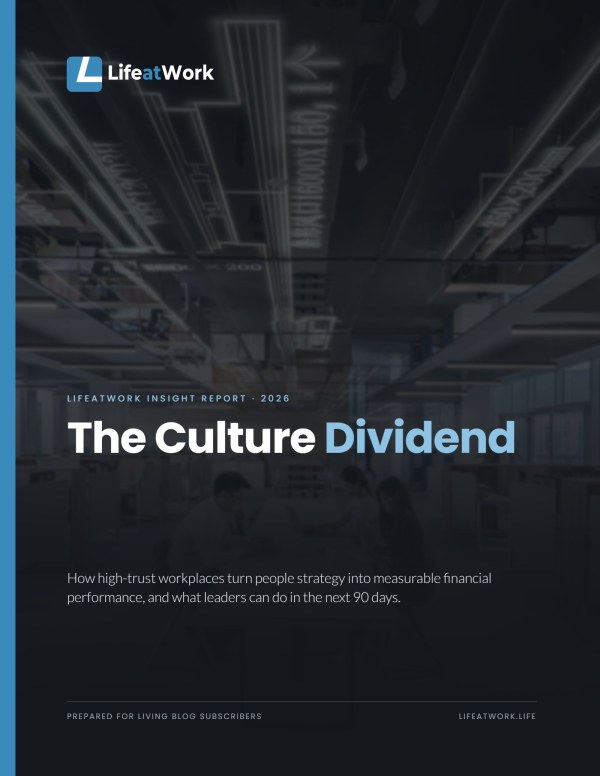
The Culture Dividend

How high-trust workplaces turn people strategy into measurable financial performance, and what leaders can do in the next 90 days.

Subscribe to The Living Blog with your email below to unlock your free download.

Cover of The Culture Dividend, a LifeatWork Insight Report

What’s inside

The case for culture, and a plan to act on it.

Culture to profit

Four decades of research and Gallup’s latest data linking culture to profit.

Trust and dignity

Trust, psychological safety, and the dignity every employee deserves.

When good people go wrong

Workplace bullying, the No Asshole Rule, and how good people go wrong in bad systems.

The truth about layoffs

The human, cultural, and financial cost.

The Four Levers Framework

An interactive self-scoring leadership assessment and a 90-day roadmap.

Questions, or ready to talk about your culture?

Call or text Kevin Kennemer directly, or email kevin@lifeatwork.life.

Call or text Kevin: 918.231.5781

Subscribe to continue reading

Subscribe to get access to the rest of this post and other subscriber-only content.

Poison Pill at Work

The Living Blog

Poison Pill at Work

By Kevin Kennemer · September 9, 2026

Commercial jetliner in flight

Two modern jetliners fell from the sky just five months apart, killing 346 people. Men, women, and children lost their lives in minutes, lives that ended in terror.

On October 29, 2018, Lion Air Flight 610 plunged into the Java Sea, killing 189 people: passengers whose families were waiting at home, coworkers expecting them at morning meetings, and loved ones anticipating their return from long‑planned trips.

Then, less than five months later, on March 10, 2019, Ethiopian Airlines Flight 302 crashed near Bishoftu, Ethiopia, killing 157 more: travelers headed to vacations, business commitments, and reunions that would never happen.

Two continents. Two airlines. Two brand‑new Boeing 737 MAX aircraft. And one cultural failure that made both tragedies possible.

When the Real Failure Is Not Mechanical

When disasters like these occur, leaders often look to engineering flaws, regulatory gaps, or breakdowns in process, but the truth runs deeper. Every leadership decision carries consequences, and some of those consequences ripple quietly for years before revealing their full weight. Acquisitions sit high on that list: seemingly strategic moves that can either strengthen a company’s identity or silently unravel it from within.

Acquisition Assimilation

Companies in acquisition mode often focus on financial fit, strategic alignment, and market expansion. But there is a question many overlook, and it often determines whether the deal becomes a catalyst or a catastrophe. Will the acquired company assimilate into your culture, or will its culture dominate yours?

Leaders who fail to understand the culture they are swallowing risk ingesting a poison pill.

Boeing’s Original Cultural DNA

For most of the 20th century, Boeing was an engineer’s company. It lived in Seattle because that is where the airplanes were built. Leaders walked the factory floors. Decisions were made by people who had spent entire careers around aircraft. One of Boeing’s core beliefs could be summed up simply as a question: Is it safe, and is it the best plane we can build?

That culture of proximity, mastery, and truth produced the 747, the 767, and the 737. Engineers and leaders disagreed often, and those disagreements led to decisions that made the airplanes better.

The Merger That Rewired the Culture

Then came the financial decision that changed everything.

In 1997, Boeing acquired McDonnell Douglas. But as many observers have argued, the merger was culturally inverted, meaning that although Boeing was the acquiring company on paper, McDonnell Douglas’s management philosophy ultimately became dominant.

The widely cited commentary that McDonnell Douglas acquired Boeing using Boeing’s own money is not a literal financial fact, but it is a powerful truth. It highlights how a cultural shift, not just a corporate transaction, can alter the trajectory of an entire organization.

The Slow Erosion of Engineering Excellence

Investigations, congressional reports, and internal Boeing communications show that beginning in the late 1990s and accelerating through the 2000s, Boeing placed increasing emphasis on costs, schedules, and shareholder value. The company that once centered its identity on engineering excellence shifted toward shareholder optimization.

Their culture did not collapse overnight. It eroded over time. And when Boeing moved its headquarters from Seattle to Chicago in 2001, the separation became both physical and cultural. The executives left Seattle, but the engineers stayed.

Leadership stopped walking the floor. Distance replaced connection.

Where Companies Lose Their Way

Profits matter. Strategy matters. Customers and investors matter. But none of it works without the people who carry the mission forward. Employees move the needle, not because management demands it, but because culture enables it.

A culture increasingly shaped by financial and competitive pressure allowed engineering concerns to be minimized, training to be reduced, and a flawed system to be certified. The two 737 MAX crashes killed 346 people, and Boeing ultimately paid more than $2.5 billion in criminal penalties, compensation, and settlements, with the total financial impact exceeding $20 billion.

In this monumental case, when culture fails, the costs are measured not only in dollars, but in lives.

Culture Is Structural, Not Soft

Culture determines whether truth travels upward, whether dissent is welcomed, and whether safety is protected. And it raises a simple, unavoidable question: Do you want to fly on an aircraft designed by a company where employees trust their leaders, feel safe to speak up, and engage in healthy debate to build the best and safest airplanes in the world?

The Poison Pill Revealed

In the end, Boeing’s story makes one truth impossible to ignore: the 737 MAX crashes were not just engineering failures; they were cultural failures born from a poison pill swallowed decades earlier.

The merger that rewired Boeing’s identity ultimately rewired its judgment. And the consequences of that cultural inversion echoed all the way to the Java Sea and the fields of Ethiopia, to families waiting at home, to loved ones expecting a knock on the door, to reunions that never happened.

So yes, company culture matters. It matters more than strategy, more than structure, and more than any spreadsheet can capture. Because when culture fails, people pay the price.

___

Kevin Kennemer is a workplace strategist, writer, speaker, and founder of LifeatWork, with more than 30 years of experience helping organizations turn culture and leadership into measurable business performance. While he is an expert in compensation and benefits plan design and communication, his work connects a strong workplace culture directly to revenue growth, stronger customer loyalty, and increased market share, making culture a competitive advantage, not simply an employee initiative.

Calling at Work

The Living Blog

Calling at Work

By Kevin Kennemer · February 26, 2026

Professional woman looking up with quiet confidence in front of a city skyline

A calling at work is not about a job title, a promotion, or the size of your paycheck. It is the quiet conviction that what you do matters: that your work is meaningful, aligned with your values, and connected to a purpose bigger than the back‑to‑back meetings on your calendar. Research shows that only about 20% of U.S. workers see their work as a calling.

That also means most people wake up, get dressed, and head to work simply because it is Monday and the bills will not pay themselves. They are not lazy. They are not unmotivated. They are just tired. Tired of surviving the day instead of living it. Tired of feeling like work drains more than it gives. If that is where you find yourself, you are not alone.

Early in my career, I lived that version of work too. I showed up, did what was required, and prayed the day would not take more out of me than I had left to give to my family. Work became something to endure, not something that added meaning to my life. And that kind of living, the slow grind of drudgery, is not good for your health, your relationships, or your spirit. It wears you down in ways you do not always notice until you are already running on empty.

I was exhausted, adrift, and desperate to live out my values of helping, comforting, and connecting with people when I was unexpectedly offered a pastor of administration role at my church, a job I wasn’t seeking but convinced myself was a miracle. Burned out and anxious, I believed stepping into ministry would transform my work life into something heavenly, only to discover the culture there was even more dysfunctional than the toxic environment I had just escaped. That jarring realization is what finally opened my eyes to the truth that calling isn’t tied to a spiritual setting at all, but to how I choose to show up in my everyday work, and that’s when the idea of a calling at work finally clicked into place.

I walked away from that job feeling crushed, discouraged, and convinced I had failed, searching desperately for answers that never seemed to come. One morning, in the middle of that heaviness, a verse in my devotional cut straight through the fog: “Whatever you do, work at it with all your heart, as working for the Lord… since you know that you will receive an inheritance from the Lord as a reward.” (Colossians 3:23–24 NIV). In that moment, I realized my calling wasn’t waiting somewhere else. It was inviting me to be faithful, purposeful, and wholehearted right where I was planted.

My mindset shifted. I decided to approach my work in business as my calling, not because the responsibilities changed, but because my purpose did. I realized that workplaces are full of people carrying stress, fear, conflict, and stories they rarely speak aloud. And in that space, Human Resources became more than a profession for me. It became a place to bring steadiness, compassion, and purpose to people who needed it.

I discovered that part of my calling is helping organizations thrive by supporting people, and sometimes that means addressing difficult behavior directly so the culture can breathe again. I still face stress, deadlines, and the pressure to get things right. There are days that are extremely difficult. But I try my best to see past those days and pray I will continue with the right mindset. They are simply part of the work I was meant to do. And that sense of calling keeps me grounded, steady, and moving forward.

If you are struggling to find your calling at work, if you are walking in at 9 with reluctance and sprinting out at 5 with relief, I want you to know there is another way. You do not have to live in drudgery. You do not have to settle for survival. Sometimes calling is not found in changing jobs. Sometimes it is found in changing how you show up.

Here are a few ways to begin living out your calling right where you are:

Serve: Begin each day with the simple intention to help someone. Not to impress, not to perform, just to serve in the moment you are given.

Calm: When someone around you feels overwhelmed, let your steadiness become the thing on which they can lean.

Listen: Offer your full attention before you offer direction. People feel valued when they feel heard.

Balance: When conflict shows up, hold compassion in one hand and clarity in the other. Grace and truth can stand together.

Reflect: Let your actions speak your values. The quiet things you do often carry more weight than anything you say.

Encourage: When someone seems discouraged or unseen, give them a word that lifts their head. Small encouragement can change the course of a day.

Honor: Even when you disagree, give others the dignity of being heard. Respect builds trust, especially in hard moments.

Own: When you miss the mark, admit it quickly and humbly. Growth begins where defensiveness ends.

Lift: Leave people lighter than you found them. Sometimes your presence is the relief they did not know they needed.

Steady: When emotions run high, choose patience. Your calm can reset the room.

Humble: Choose humility over certainty. It keeps your heart open and your relationships healthy.

Support: Look for ways to lift others up, especially when they are carrying more than they can say aloud.

Persist: Purpose is not lived in grand gestures. It is built through small, faithful choices repeated over time.

Kindness: Let kindness shape your tone, even when firmness is required. Strength and gentleness can coexist.

Grow: Keep learning, keep stretching, and keep showing up with a willing heart. Growth is part of your calling too.

Laughter at Work

The Living Blog

Laughter at Work

By Kevin Kennemer · February 16, 2026

Colleague laughing at her laptop during a meeting

Laughter is more than a pleasant moment. It is a physical and mental reset. It increases oxygen flow, relaxes muscles, lowers cortisol, boosts immunity, and releases endorphins that help the body recover from stress. Mentally, it reduces anxiety, sharpens thinking, and strengthens resilience. As neuroscientist Dr. Sophie Scott explains: “Laughter is a social behavior that helps regulate stress and build connection.” In today’s workplace, where people arrive already carrying pressure, laughter is not optional. It is essential.

Having Fun at Work is Serious Business

There is a belief floating around that leaders must always be serious to be taken seriously. That idea concerns me. As a leader, I enjoy having a light‑hearted environment where people can laugh. I feel good when my people laugh while they work. I expect excellence (that part never changes), but I also know the importance of enjoying what you do and having fun with your coworkers. Team members do their best work when they have the freedom to enjoy their work. “A happy heart is like good medicine, but a broken spirit drains your strength.” Proverbs 17:22 (NCV)

Laughter is a Competitive Advantage

Teams that laugh together are not less professional; they are more connected, more creative, and more resilient. Laughter lowers defensiveness, builds trust, and opens the door to honest communication. It helps people recover from setbacks faster and approach challenges with clearer minds. A team that can laugh together can weather storms together. A team that cannot laugh is usually a team that is holding its breath. Joy does not dilute excellence. It fuels it.

Fun at Work Is a Leadership Choice

Creating space for laughter is not lowering standards. It is raising the emotional capacity of the team. It gives people permission to be human in an environment that often demands perfection. The workplace should be a place where people experience dignity, connection, and moments of joy that remind them they matter. Laughter is one of the simplest ways to bring light into a stressed‑out workplace. It is healing. It is human. And it just might be the spark that helps someone make it through the week.

As you consider this topic, review these key points as you rise above your competition.

  • Relief: Laughter reduces stress hormones and boosts mood within minutes.
  • Connection: Teams that laugh together communicate more openly and solve problems faster.
  • Creativity: A light‑hearted environment increases creativity and psychological safety.
  • Engagement: Leaders who allow joy at work often see higher engagement and better performance.
  • Excellence: Fun is not the opposite of excellence. It is one of its strongest foundations.
  • Science: Studies show that shared laughter synchronizes brain activity, improving group cohesion and collaborative problem‑solving.

Trust at Work

The Living Blog

Trust at Work

By Kevin Kennemer · January 28, 2026

Two colleagues smiling and shaking hands across a desk

Early in my career, I experienced a pivotal moment that positively changed my life at work. It was an epiphany, a mental “click” that has guided me throughout my career. This moment of clarity occurred at a leadership luncheon in Tulsa, Oklahoma. The speaker was Scott Caewood1 with the Great Place to Work Institute. I had never heard such a compelling, fact-based presentation about the direct link between great places to work and financially successful companies.

Caewood’s compelling, scientifically based presentation proved that most financially successful companies in the United States had one ingredient that was the difference maker: trust. Trust, not perks, benefits or programs was, he said, the real engine behind great workplaces, and great workplaces are what ultimately drive long-standing, financially successful companies.

The Institute defines a great place to work as one where “employees trust the people they work for, take pride in what they do, and enjoy the people they work with.”

Trust is a soft idea that delivers hard results. Let’s look at the specific benefits to organizations with high-trust cultures…

Benefits to companies with high-trust cultures:

Financial: 4x greater stock returns

Talent: 15x more attractive to job seekers

Retention: 50% less turnover

Agility: 27% increase in ability to thrive during change

Innovation: 200% greater employee-led innovation

Productivity: 86% benefit from employees giving extra effort

Benefits to employees working in high-trust cultures:

Better overall well‑being: Employees are nearly 4x more likely to feel holistically healthy (physical, mental, social, and financial).

Higher engagement and motivation: Employees are 2x as likely to be engaged and 60% more motivated to work.

Lower burnout, absenteeism, and turnover: Employees have 41% lower absenteeism and are 50% less likely to look for another job, meaning more stability and less job‑hunting stress.

Greater ability to adapt and thrive: Employees are 28% more likely to adapt quickly to change and perform better under pressure because of these supportive cultures.

More willingness to go above and beyond: Employees are 42% more likely to give extra effort to get work done and feel psychologically safe to contribute, collaborate, and take initiative.

More innovation and creativity: Employees are 45% more likely to say their workplace celebrates innovation and trying new things by reducing fear of failure, which unlocks creativity.

Stronger sense of belonging and connection: Employers foster open communication, recognition, fairness, and listening, the behaviors employees say matter most. This leads to deeper camaraderie and a more enjoyable work experience.

Great workplaces are the responsibility of leaders, and they create a high‑trust environment by consistently demonstrating credibility, respect, and fairness, the three pillars at the core of the Great Place to Work Trust Model. These behaviors shape the employee experience, and determines whether they feel safe, valued, and motivated.

Credibility: Credibility grows when leaders communicate clearly and follow through on their commitments. People trust management when words and actions consistently align.

Respect: Respect is built when leaders listen, involve employees, and support their success. When people feel valued as individuals, they bring more energy and commitment to their work.

Fairness: Fairness comes from consistent treatment, transparent decisions, and a level playing field. Employees trust leadership when opportunities and accountability are applied without favoritism.

It has been over thirty years since that career-changing presentation, and it still holds true. While there are volumes that can be written about this topic. If you are a leader, or aspiring leader, I hope my transformative experience will motivate you to explore, share and model this in your life at work.

  1. Currently, Dr. Scott Caewood is the CEO of WorldatWork, the global nonprofit association focused on compensation, benefits, and total rewards. ↩︎

Anxiety at Work

The Living Blog

Anxiety at Work

By Kevin Kennemer · January 21, 2026

Woman resting her head in her hands, looking down with a worried expression

My entire life I have suffered from anxiety, especially in the mornings. My anxiety does not require a trigger. It is a mental health condition I have lived with my entire life. It was not until I was thirty-eight that I was diagnosed with Generalized Anxiety Disorder (GAD), the term for excessive and persistent worry from real or perceived threats.

When I was young, you did not talk about mental health conditions. Suffering from mental health conditions was considered a weakness. You could be shunned or made to feel like an outcast. My mother told friends and family I dealt with a nervous stomach. While true, it was an acceptable explanation.

Almost 3% of the population has been diagnosed with GAD, and about 6% will experience it at some point in their lives. In contrast, stress and anxiety in the workplace are far more widespread. On any given day, 80% of employees report stress or anxiety that undermines productivity, and 60% experience exhaustion, irritability, sleeplessness, and related symptoms.

Many well-known and highly successful individuals live with persistent anxiety, among them Elon Musk (Tesla, SpaceX), Arianna Huffington (HuffPost), Brian Chesky (Airbnb), Sheryl Sandburg (Former COO, Meta), Ben Silbermann (Pinterest), Kendra Scott, Stewart Butterfield (Slack),  Adele, Evan Williams (Twitter, Medium), Selena Gomez, Howard Schultz (Starbucks), Rihanna, Satya Nadella (Microsoft), Oprah, Tim Cook (Apple), Bob Iger (Disney), Sara Blakely (Founder, Spanx), Reed Hastings (Netflix), Warren Buffet, Isaac Newton, Kevin O’Leary (SharkTank). And the list could go on.

Throughout my life, I have prayed for my anxiety to go away, but to no avail. Sometimes the only way forward is to work through our pain. And while persistent anxiety is a difficult, life‑altering condition, it can also carry unexpected advantages.

If you live with anxiety, it is important to recognize that your condition can also bring meaningful strengths. A wide range of research shows that people with GAD often develop valuable attributes in the workplace, including:

  • Culture: Tend to create cultures where others feel supported.
  • Awareness: Heightened sensitivity to the tone in the room and interpersonal dynamics.
  • Anticipation: Ability to anticipate problems early and prevent mistakes.
  • Preparation: With a fear of making mistakes, they are prone to over prepare and tend to have contingency plans.
  • Team Builder: Ability to create, support, and maintain great teams that are effective and difference makers.
  • Peacemaker: Understand opposing views and work to prevent or resolve conflicts.
  • Psychological Safety: Sensitive to the needs of coworkers and understand the importance of teams who can safely express their opinions and ideas without fear.
  • Coaching: Motivation to invest in coworkers and direct reports through mentoring and coaching.

If you suffer from anxiety or another mental health condition, find a way to use your pain to help others. Sharing your struggles can help those who feel isolated and think they are the only ones who suffer from anxiety. Hopefully, my willingness to talk about my pain will help you in your life and work.

Commitment at Work

The Living Blog

Commitment at Work

By Kevin Kennemer · January 6, 2020

Professional walking to work along a quiet city street at sunrise

To be a good example, you must be committed to your job.

Commitment means you will put forward the effort to get the job done. Commitment means you will go above and beyond what is expected.

There will be times you will need to arrive early and work late. There will be times you can work normal hours. It depends on your work load.

Commitment does not require you to be a workaholic. It does not mean you will sacrifice your family for your job. It means you will get the work done while putting family above your job. Your level of commitment to family should not be superseded by your career.

Considering this balancing act, you must fully understand how to prioritize. It is not easy to juggle your faith, family and career. It requires working smart.

We were created to enjoy work. There is fulfillment from getting work done, and it makes time with family more rewarding. Investing in your family, on the other hand, makes work more enjoyable because your job will benefit your family. Your job provides resources to support your family.

If you take a job, you should be all in. Make a commitment to your employer, or your business if self-employed.

If you are lacking commitment at work, approach your career as a ministry to others. Commitment at work provides a good example to others.

Perspective at Work

The Living Blog

Perspective at Work

By Kevin Kennemer · January 2, 2020

Family holding hands at the edge of the ocean, facing the waves

You will not leave this earth alive.

Life expectancy in the U.S. is 79 years. Eventually, your life will end, then you will stand before God to account how responsible you were with the talents you were given. How did you treat others? Did you serve to others?

You will be accountable for your life. You will also be accountable for your actions at work. Yes, you will be accountable to God for your 9 to 5 life. Many people incorrectly think what you do at work has nothing to do with life.

As a leader, you will be accountable for how you treated your employees. Serving and treating those you lead with dignity and respect: these actions will be evaluated.

You should live each day with the perspective your life will eventually end. My hope is you live a very long, productive, rewarding and healthy life. There is, however, a beginning and an end.

The realization of death provides perspective on life and work.

Fun at Work

The Living Blog

Fun at Work

By Kevin Kennemer · December 31, 2019

Neon sign reading work and play

Work without fun is drudgery.

Intrinsically, people want to work and be productive. God created us with the desire to work and make a difference. It’s in our DNA.

When you hire the right people, productivity will not be an issue. As a leader, your job is to be a motivator, coach, teacher and counselor. It is also important to promote fun in the workplace.

Fun and work is not mutually exclusive. If you cannot have fun at work, your people will not go above and beyond their job responsibilities; they will not expend discretionary effort.

Work is not always fun but we must make the best of it when it’s not. There is a time to be serious. There is also a time when the environment should be light-hearted.

This idea is not rocket science. This leadership principal is simple. We need to be reminded to have fun in life and work.

Go ahead, promote fun in the workplace.